- Huangshan Is a Region, Not a Peak to Bag
- Getting Up: Three Cable Cars and the Cost of Walking
- Sleeping on the Mountain Is the Decision That Shapes the Trip
- Routing the Summit: Beihai, Xihai, Bright Summit and Shixin
- The West Sea Grand Canyon: The Best and Hardest Stretch
- Weather Decides Everything: Cloud Seas, Rime and White-Outs
- Hongcun and Xidi: Choosing Between Two Villages
- Huizhou Is More Than Villages: Archways, Halls and Merchants
- How Many Days? Two, Three and Four
- Getting There from Shanghai, Hangzhou, Hong Kong and Taiwan
- Comparison Table: Staying on the Mountain vs Below
- Fitness and Knees: Who It Suits and Who Needs Adjusting
- Five Common Mistakes at Huangshan
- Why a Tailor-Made Trip Pays Off Here
- In Closing: Huangshan Rewards Waiting, Not Rushing
Huangshan Is a Region, Not a Peak to Bag
Most people imagine Huangshan as a straightforward transaction: buy a ticket, climb up, watch the sunrise, come down. The scenic area is far larger than that. The summit splits into several zones, each twenty to forty minutes of walking from the next, each with its own views and its own crowds. Below the mountain sits Tangkou, the town that exists to serve it, and beyond that are Tunxi old town, Hongcun and Xidi, which are separate destinations entirely.
That structure has two consequences. First, one day is not enough, because getting up, walking a zone and getting down consumes most of a day before you have waited for any light at all. Second, where you sleep is not a comfort question, it is a question of whether the itinerary works. Base yourself at the bottom and you will spend two or three hours a day in cable cars and shuttle buses.
There is a third thing visitors routinely underestimate: the vertical scale. This is not a gentle trail. It is thousands of stone steps, and a full day on them is a genuine load on the knees. That is exactly why the cable cars are not an option for the unfit. For most travellers they are simply part of how the mountain is done.
So the first planning decision is not a list of viewpoints. It is accepting that Huangshan is a place you sleep inside. Once that is settled, the day count and the hotel choice follow.
Getting Up: Three Cable Cars and the Cost of Walking
Three cableways serve the mountain: Yungu on the back side, Yuping on the front, and Taiping to the north. A fourth, the funicular inside the West Sea Grand Canyon, is an internal shuttle rather than a way up. Most visitors ride up one side and down another.
Our usual recommendation is up by Yungu and down by Yuping. The back side is gentler and the viewpoints are closer together, so your freshest hours go on Shixin Peak and the Beihai area, which is where you want them. The front side around Yuping is steeper, but descending is easier than climbing, and it lets you finish at the Greeting Guests Pine rather than starting there.
Walking up is possible and we would not talk anyone out of it, but be honest about the arithmetic: the stone staircase from Yungu Temple up to Baieling is two to three hours of continuous ascent, and the views along it are not the reason people come. Unless the climb itself is the point, your energy is better spent on the summit zones.
Queues are the other variable. In peak season, eight to ten in the morning is the crush, and waits of over an hour are normal. Two ways around it: start very early, or push the ascent into the afternoon, when the flow thins noticeably and the light is better for photographs anyway.
Sleeping on the Mountain Is the Decision That Shapes the Trip
Sunrise and cloud seas at Huangshan happen in the early morning, almost without exception. From Tangkou at the foot, catching sunrise means getting up at three or four, queueing for a cable car, and possibly still missing the first one. Sleeping on the mountain means walking out of your hotel at half past five. That difference is the difference between having the photograph and not having it.
Summit accommodation clusters around Beihai, Xihai and Yuping. There is not much of it, and it is not luxurious: rooms are small, hot water runs on a schedule, and food is limited and expensive. Those are facts and we would rather state them plainly. What you are buying is time and opportunity, which on this mountain are the scarce things.
If budget and energy allow, our advice is one night on the summit within a three or four day trip. With a single night, put it in the Beihai or Xihai area: close to the sunrise points such as Shixin Peak and the Cool Terrace, and convenient for the West Sea Grand Canyon the following morning.
The reverse is equally legitimate. If sunrise is not something you care about and you simply want to walk the mountain and see it, staying below is perfectly workable and far cheaper. It is not a right or wrong choice. It is a question of what you came for.
Routing the Summit: Beihai, Xihai, Bright Summit and Shixin
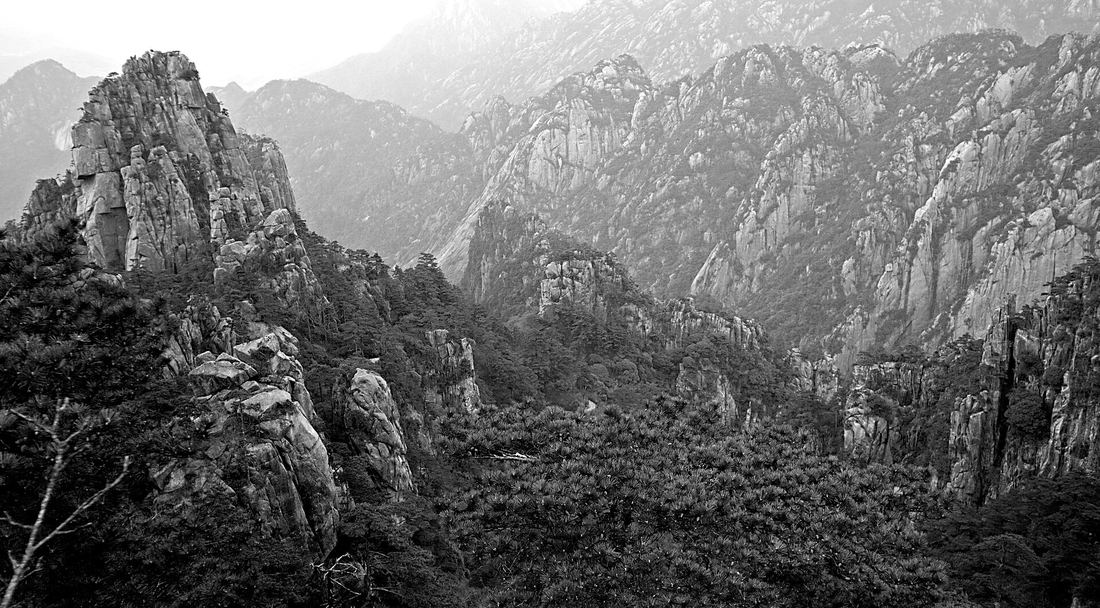
The summit divides into four usable blocks. Beihai and Shixin Peak in the north-east give you the stone pillars and pine forest. Xihai in the north-west is the main stage for sunset and cloud seas. Bright Summit Peak sits centrally and is one of the highest points, with wide open views. Yuping and the Greeting Guests Pine anchor the south-east and belong to the front approach.
A typical day and a half looks like this. Ascend in the afternoon and walk Shixin Peak and Beihai, reaching Xihai for sunset, and sleep on the mountain. The next morning, take sunrise, then walk the Flying-Over Rock and Bright Summit Peak, descend into the West Sea Grand Canyon, and exit by the Yuping cableway. The line flows without backtracking and distributes the effort sensibly.
One caution: distances up here do not behave like distances on flat ground. Two points a kilometre apart on the map can be forty minutes of up and down. Build the route around ascent, not around horizontal distance.
A practical detail worth knowing: signage on the mountain is good, but there are many junctions. Rather than memorising a route, fix two coordinates in your head, which is where you sleep tonight and which cableway you leave from tomorrow. Everything in between can wander without doing real harm.
The West Sea Grand Canyon: The Best and Hardest Stretch
The West Sea Grand Canyon is the section people rave about most in recent years. The walkway clings to the canyon rim, the floor drops away beneath you, and the far wall is a stack of stone towers. The concentration of scenery is genuinely high, and many visitors rate it above Bright Summit Peak.
It is also the most demanding. The canyon trail takes three to five hours end to end, dropping and then climbing again with serious vertical gain and a great many steps. When you finish, there is usually still an ascent back to the main route, and that is often the hardest hour of the whole trip.
The internal funicular shortens part of it, but not all of it, and you will still walk a long way. If your knees or your fitness are average, walk one section, the first or second loop, and turn back. You will see the best of it without emptying the tank.
We place the canyon in the middle of the itinerary and avoid loading the same day with other zones. Leave some slack afterwards rather than rushing to the next viewpoint. This stretch deserves to be walked slowly, not treated as a box to tick.
Weather Decides Everything: Cloud Seas, Rime and White-Outs
Huangshan is famous for its cloud sea, and the cloud sea is not a daily event. It needs specific humidity and temperature conditions, and it usually appears after rain clears or on clear autumn and winter mornings. Which means the two days you booked may show you nothing at all, or may show you something you remember for the rest of your life.
The seasons offer different things. Spring brings azaleas and new green, along with plenty of rain. Summer is cool and genuinely pleasant as an escape from the heat, but afternoon thunderstorms are common. Autumn has crisp, clear air and is the season most people call the most comfortable. Winter brings rime and snow, thin crowds and clean light, at the cost of possible path closures and a real need for proper cold-weather clothing.
The practical response to all that uncertainty is buffer, not hope. Two nights on the summit instead of one doubles your chances. A flexible day in the itinerary lets you move the villages forward when the mountain disappears into fog. That is the only lever you actually have.
It is also worth accepting the other outcome. Fog swallowing Huangshan is normal, not exceptional. Plenty of visitors have stood on a viewing platform staring into white. When that happens, switching to Hongcun, Xidi or Tunxi old town is a better use of the day than standing around waiting for a miracle.
Hongcun and Xidi: Choosing Between Two Villages
Hongcun and Xidi are both part of the ancient villages of southern Anhui inscribed together as a World Heritage site, but they have different temperaments. Hongcun is built around water, and the Moon Pond and South Lake turn the whole village into a reflection. The images are extraordinary, which is exactly why it is the busiest and most commercialised.
Xidi is more ordered. Archways, ancestral halls and lanes are preserved intact, there are noticeably fewer visitors, and it is quiet enough to hear yourself walk. If you are choosing one and crowds bother you, Xidi is usually the more comfortable experience. If you want the reflection photograph, Hongcun has no substitute.
What both share is the same advice: stay a night, or at least stay until evening. Group tours arrive between about ten and four, and during those hours the villages are something you are carried through rather than somewhere you walk. Early morning and late afternoon are when they revert to themselves.
Hongcun is roughly an hour by road from the foot of the mountain, on decent roads. Many visitors treat it as a rest stop on the way down, which wastes it. It deserves half a day and a night, not a two-hour photo call.
Huizhou Is More Than Villages: Archways, Halls and Merchants
The core of Huizhou culture is a group of people: the Huizhou merchants. In the Ming and Qing dynasties they left to trade, came home wealthy, and spent that wealth on ancestral halls, grand houses and memorial archways. Everything you see in these villages is downstream of that one story. Understand it and you are no longer just looking at old buildings.
The Tangyue Archway Group is the most concentrated expression of it: seven arches standing in a row, each attached to a different story of loyalty, filial piety, chastity or righteousness. It photographs less well than a village, but if you are interested in how families and the state organised themselves, it carries more information than any old street.
The details in the halls and houses repay attention too. The courtyard drainage, the fire walls with their stepped gables, the subjects carved in wood: all of it was designed for living, not for tourists. Having someone explain it makes an enormous difference to what you take away.
With only half a day, we usually suggest one village plus one archway group rather than three villages. Depth beats coverage in places that require context, and this is one of them.
How Many Days? Two, Three and Four
Two days is the floor: one up and down the mountain, moving quickly, and one for Hongcun or Xidi. You will touch the main scenery, but there is no room to wait for weather and nothing about it is unhurried.
Three days is what we recommend to most travellers. Arrive and ascend in the afternoon, sleeping on the summit. Take sunrise the next morning, walk Xihai and Bright Summit Peak, and descend in the afternoon. Give day three to the villages. The mountain and the villages each get a full day, and the pace holds together.
Four days or more lets you add Tunxi old town and the Tangyue archways, or continue south towards Qiandao Lake and Hangzhou for a route that combines mountains with water towns. More layers, and a reason for the longer transfer.
One honest caveat: with a tight schedule, a single morning of thick fog or a suspended cableway leaves you no room to rearrange anything. At Huangshan, one extra day is worth considerably more than one extra viewpoint.
Getting There from Shanghai, Hangzhou, Hong Kong and Taiwan
Huangshan has Tunxi International Airport and Huangshan North railway station. High-speed trains run direct from Shanghai, Hangzhou and Nanjing, taking roughly one and a half to two hours from Hangzhou and about three from Shanghai. Rail is the most convenient approach at present.
From Hong Kong or Taiwan there are two usual options. Fly to Hangzhou or Shanghai and continue by rail, or fly direct to Tunxi, which has fewer services and depends on the season. The rail connection is not necessarily slower overall, and the frequency and resilience to delays make it the choice most of our guests end up with.
From the station or airport it is about an hour to Tangkou at the south gate, then a scenic-area shuttle to the cableway station. This transfer chain is where independent travellers most often come unstuck: shuttle timetables, left luggage and queueing all take time that is not in the plan.
China Custom Tours, part of the JoyoTour group, handles this region by arranging transfers, cableway tickets and summit accommodation together. Private vehicles take no strangers and drivers are kept separate from guides, Hong Kong guests travel with a Cantonese-speaking guide and Taiwan guests with a Mandarin-speaking one, there are no shopping stops, and quotations are itemised.
Comparison Table: Staying on the Mountain vs Below
The table below sets the two bases side by side so you can match one to what you actually want.
| Factor | On the summit | Below, in Tangkou |
|---|---|---|
| Cost of seeing sunrise | Walk out of the hotel at 5:30 | Up at 3 or 4, queue for a cable car, may still miss it |
| Room quality | Small, scheduled hot water, limited food | Wide choice, better rooms, flexible prices |
| Price | Noticeably higher, especially in peak season | Comparatively cheap |
| Luggage | Carry up or have it portered; bring one day of kit | Leave it at the hotel and travel light |
| Suits | Travellers chasing sunrise and cloud sea, short on time, willing to pay for the chance | Travellers indifferent to sunrise, budget-led, or with small children and limited mobility |
| Days needed | One or two nights up top, three days or more overall | Two days works, but it is rushed |
One practical warning: summit rooms are few, they sell out early in peak season, and cancellation terms are strict. We handle this kind of booking in advance and explain the conditions up front, so nobody discovers at the gate that the room is gone or cannot be changed.
Fitness and Knees: Who It Suits and Who Needs Adjusting
The physical demands here are real. Continuous stone steps, repeated climbs between zones and the long vertical drop of the West Sea Grand Canyon are a genuine challenge for anyone with bad knees or a heavy build. Saying so is not discouragement. It is what makes a workable plan possible.
Travelling with older relatives is entirely feasible with adjustments: use the cable cars and the canyon funicular, skip the canyon, cap daily walking at three to four hours, and choose accommodation close to a cableway station. The same sights at a different tempo feel like a different trip.
With young children there is a different consideration. Most summit paths have railings, but some viewing platforms drop away sharply at the edge and need a hand held throughout. Temperatures on top run well below the valley, so proper warm layers are needed even in summer.
When we plan, we set out the daily walking distance and the approximate ascent before you commit. Knowing what you are walking into is far more comfortable than finding out at the top.
Five Common Mistakes at Huangshan
The first is assuming the mountain can be done in a day. Getting up, walking a zone and getting down takes most of a day before queues are counted, and there is no time left to wait for light.
The second is staying at the bottom and expecting sunrise. The uncertainty of a pre-dawn cable car queue is too high, and plenty of people spend the effort and see nothing. If sunrise matters, sleep on the mountain. That is the only solution.
The third is putting the West Sea Grand Canyon on the last day. It usually leaves you spent, with a cableway and a drive still ahead. Place it mid-trip and leave slack afterwards.
The fourth is treating Hongcun as a two-hour stop en route. Between ten and four it is a crowd you are carried through. Go early, or stay the night.
The fifth is underestimating the cold and the damp up top. Even in summer, a summit morning can sit in the low teens, and wind and fog make it feel colder. Warm layers are not optional equipment.
- If you want sunrise, sleep on the mountain; staying below hands your chances to a cable car queue
- Go up by Yungu and down by Yuping for the best distribution of effort
- Put the West Sea Grand Canyon mid-trip and do not stack other zones onto the same day
- Keep one flexible day; fog closing in is the norm, not an accident
- Visit Hongcun early or stay overnight; do not walk in at midday
Why a Tailor-Made Trip Pays Off Here
The hard part of Huangshan is not deciding where to go. It is stitching together bookings and transfers. Summit beds are limited, tickets and cableways run on real-name reservation, the chain from the station to the cableway is fiddly, and the weather rewrites plans without warning. Together those turn what should be a magnificent trip into an exercise in admin.
China Custom Tours, part of the JoyoTour group, arranges it by putting accommodation, tickets, vehicles and guides together. Private vehicles take no strangers and drivers are kept separate from guides, so nobody is driving while hunting for a shuttle stop. Hong Kong guests travel with a Cantonese-speaking guide and Taiwan guests with a Mandarin-speaking one, so nothing is lost in translation.
Our service hours are 09:00 to 21:00 Beijing time daily, with one consultant coordinating on WhatsApp and a 24/7 emergency response. When mountain weather turns or a cableway stops running, that line is what lets the day be rearranged rather than written off.
The team was founded in 1999 and now includes 150 itinerary designers, with more than 100,000 guests served. The operating entity is Qinghai Youxuan Culture and Tourism Co., Ltd. Those numbers will not produce a cloud sea for you, but they do mean somebody is on the ground handling the changes.
In Closing: Huangshan Rewards Waiting, Not Rushing
Many people go up Huangshan for a photograph. What the mountain actually gives you is usually unplanned: cloud rising out of the valley, fog parting to reveal a wall of stone, the whole ridge still blue at half past five in the morning.
None of that fits in a schedule. It can only be bought with time. The same three days can be a sequence of transfers, or paced so that waiting becomes possible. The difference is not how many zones you covered. It is how much room you left.
If you already have rough dates and a day count, tell us what you have in mind. Within one working day we will send a day-by-day itinerary, an itemised quotation, and pacing suggestions adjusted for whoever is travelling with you.