- Guilin and Yangshuo Are Two Different Places
- The Li River: Four Ways to Do It, Four Different Trips
- Xingping and the Twenty-Yuan View
- The Yulong River: The Drift Many Travellers Prefer
- How Many Days Do You Need? Three, Four and Five
- Guilin City or Yangshuo: Where to Stay
- Yangshuo on Two Wheels: Cycling and the Ten-Mile Gallery
- The Longji Rice Terraces: Worth the Extra Days?
- Getting There and Getting Around
- Weather and Seasons: When to Go
- Comparison Table: Choosing Your Li River Experience
- Villages and Minority Culture: How to See It Properly
- Five Common Mistakes in Guilin and Yangshuo
- Why a Tailor-Made Trip Pays Off Here
- In Closing: The Space Between Is the Point
Guilin and Yangshuo Are Two Different Places
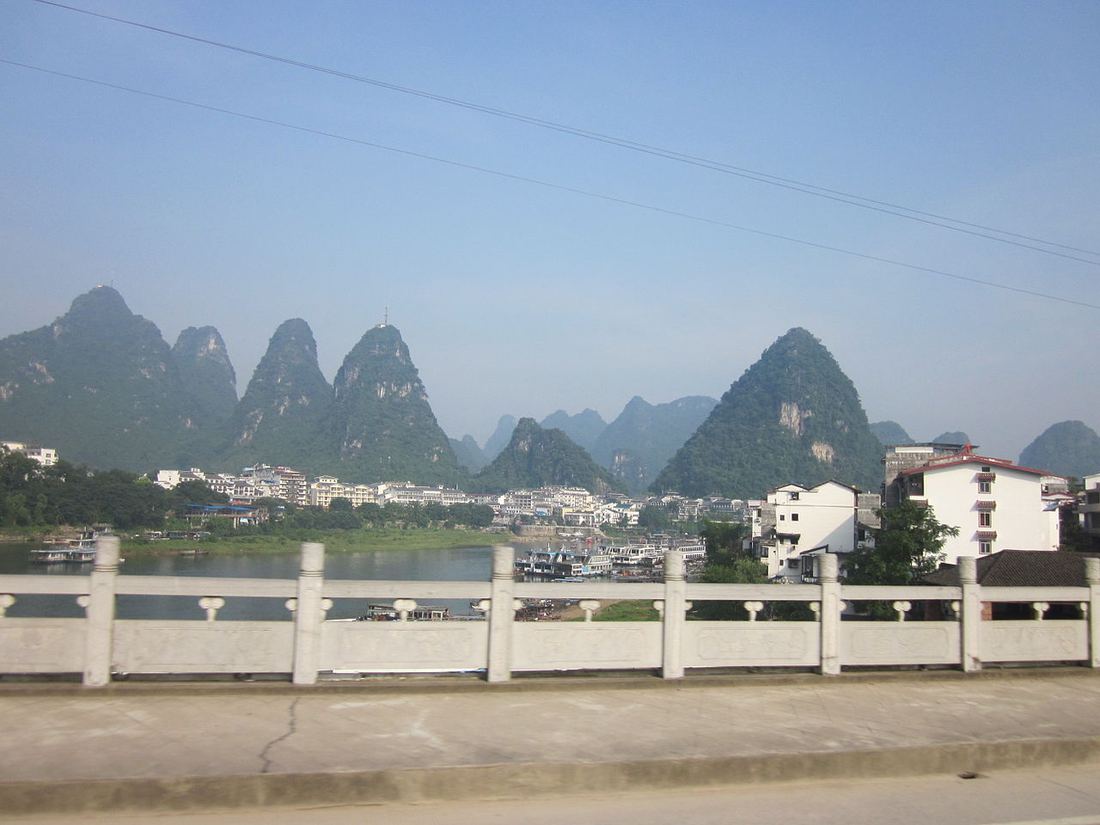
Most visitors treat Guilin as one destination. In practice it splits into three connected but separate parts: Guilin city, the Li River corridor, and Yangshuo county. The city is the transport hub, with the airport, the high-speed rail stations and most of the hotels. The Li River is the waterway linking the two. Yangshuo is the part of this karst landscape where it actually makes sense to slow down and stay several nights.
Why does the distinction matter? Because the answer to how many days you need depends entirely on which piece you are building the trip around. Base yourself in Guilin city and you will find an ordinary Chinese city where the scenery is always somewhere else. Base yourself in Yangshuo and you wake up surrounded by fields, rivers and hills, but every arrival and departure costs you time. The experiences are not variations of each other. The prices are not either.
One easily missed detail: Guilin city sits sixty to eighty kilometres from Yangshuo, roughly an hour by expressway, or four to five hours by water. That single fact decides whether you spend your holiday moving every day or staying put, and it sets the rhythm of the whole trip.
So the first planning decision is not which sights to include. It is a simpler question: do I want a city or do I want countryside? Once that is answered, the day count and the hotel choice almost settle themselves, and every later decision gets easier.
The Li River: Four Ways to Do It, Four Different Trips
The Li River is Guilin's signature, and the stretch travellers prize most runs between Yangdi and Xingping. The catch is that four quite different products all trade under the same name. The prices, the timings and the experience diverge sharply, and plenty of visitors only realise they picked the wrong one on the way home.
The first option is a large cruise boat, boarding at Zhujiang or Mopanshan wharf in Guilin and running all the way to Yangshuo, four to five hours in total. It is comfortable, with fixed seating and food on board, and it suits families travelling with older relatives. The drawbacks are size and volume: the boats are big, the decks get crowded, decent photo positions have to be claimed, and you are watching the scenery from a distance rather than being in it.
The second option is a bamboo raft or small motorised raft on the classic section, usually boarding at Yangdi and finishing at Xingping, taking one to two hours. This is the most beautiful part of the river, the rafts are small, you sit close to the water, and this is where the photographs everyone recognises come from. It also means queues in peak season and real exposure to water levels and weather, with services suspended after heavy rain.
The third option is walking, or a mix of walking and rafting, following the country lanes beside the river for part of the route. The fourth is a private car or self-drive along the riverbank, stopping at the main viewpoints. Both are more flexible, but they only work well if somebody has worked out the timings and the drop-off points in advance, or the day turns into constant driving with little to show for it.
Which one you choose depends on who is travelling and how long you have. Our advice is straightforward: older relatives and small children on the large boat, couples and photographers on the classic-section raft. With enough time, doing one of each is genuinely worthwhile, because looking at mountains from mid-river and looking at a river from the bank are not the same experience.
Xingping and the Twenty-Yuan View
Almost everyone has seen the definitive Li River image, whether in a textbook or on a banknote: rounded karst peaks standing beside calm water while a bamboo raft slides past. That spot is near Xingping, and it is usually called the twenty-yuan note view.
Xingping itself is a very small old town. The main lane takes fifteen minutes to walk. Its value is not the old town but its position: it is where the classic river section ends, and it is the base for the photograph everyone comes for. Many travellers treat it as a quick stop on the way through. It deserves half a day.
The result depends on two things above all: light and water level. Early morning and late afternoon light is the most beautiful, though also the busiest in peak season. When the river is low, broad sandbanks appear and the composition changes from the picture you have in your head. That is exactly why we keep a flexible slot rather than fixing a single unmissable day.
If you want the view without crowds, the practical move is to stay a night in Xingping and go early the next morning. Day-trippers usually arrive after ten, so being two hours ahead of them gives you a completely different Li River: one quiet enough to hear the water.
The Yulong River: The Drift Many Travellers Prefer
The Yulong is a tributary of the Li inside Yangshuo county, narrower, clearer and with the hills much closer. Its main activity is a bamboo raft drift from upstream, taking roughly one to one and a half hours, passing several low weirs that the raft slides over, a small thrill that tends to be what people remember.
Many travellers who have done both say the Yulong beats the Li. The reason is scale. On the Li you are on a big river looking at distant hills. On the Yulong you are moving through farmland, with rice fields, water buffalo and villages on both banks and the hills close above your head. That feeling of the landscape travelling with you is something a large boat cannot provide.
To be clear, the Yulong is also affected by water levels and weather. Drifts can be suspended in the rainy season, and in dry spells the route and starting point are adjusted. Queues in peak season are also real, so the earlier in the morning the better: fewer people and softer light.
We normally put the Yulong on the second day in Yangshuo and give the first day to the classic Li section or the Ten-Mile Gallery. That way each day has its own theme: one day on water looking at hills, one day cycling through fields, rather than two days on boats or two days in a car.
How Many Days Do You Need? Three, Four and Five
Three days is the tight version: one day for the Li River or the classic raft section, one day for Yangshuo's countryside combining the Yulong and the Ten-Mile Gallery, and one day back in Guilin city for Elephant Trunk Hill, the Prince of Jingjiang's residence or the Two Rivers and Four Lakes cruise. You will cover the headline sights, but there is a lot of moving and almost no buffer.
Four days is what we recommend to most travellers. The extra day lets you add a night in Yangshuo and turn the trip from ticking off sights into staying somewhere. Much of Yangshuo's appeal hides in the late evening and early morning, when the day-trippers have gone and West Street and the riverbank return to something closer to their normal selves.
Five days or more and the route can widen. The classic addition is north to the Longji rice terraces, staying a night for sunrise and cloud, or south towards Nanning and the coast. The first is mountain terrace scenery, the second coastal and border country. They point in opposite directions, so the choice depends on the season and who is travelling.
One caution: Guangxi weather changes fast, especially around the change of seasons. With too few days, a single heavy rainfall leaves you almost no room to rearrange anything. Keeping one flexible day is the cheapest insurance on this route. It does not buy another sight. It buys not having to compromise.
Guilin City or Yangshuo: Where to Stay
This is the question we are asked most often and the one most often answered wrongly. Guilin city offers convenience, a wide range of hotels and every price bracket, which suits anyone with an early flight, a train to catch or a trip up to Longji. Yangshuo offers atmosphere, countryside on the doorstep and life in the evening. It is not a question of better or worse, only of what you want.
If Longji or an early high-speed train is on the plan, staying in Guilin city is more sensible. If the emphasis is the river and the countryside, one or two nights in Yangshuo makes the whole trip more comfortable, because what you save is up to two hours of daily driving.
One easily overlooked detail in Yangshuo: hotels near West Street are convenient and loud, while guesthouses towards Xingping or along the Yulong are quiet with better views but a fifteen-minute drive into town. Families with children or older relatives usually do better with the second group, because rest quality matters more than stepping straight out onto the old street.
In our tailor-made itineraries we confirm each property individually, its exact location, its room types and its soundproofing, rather than quoting a vague same-category hotel. In a small county town that phrase can mean almost anything, and two addresses on the same lane can be very different places to sleep.
Yangshuo on Two Wheels: Cycling and the Ten-Mile Gallery
The most enjoyable way to see Yangshuo is by bicycle. A loop along the Yulong, the Ten-Mile Gallery or the back lanes runs fifteen to twenty-five kilometres, and stopping as you please gives you a far better view than any sightseeing bus. Electric bikes and geared bicycles are easy to rent locally, and dedicated cycling lanes exist along much of the route.
The Ten-Mile Gallery is the best known cycling and touring road out of town, with a handful of small ticketed sights along it such as Moon Hill and the Big Banyan Tree. Its value lies in the road itself rather than those attractions. Plenty of people buy tickets for the sights and then decide the road was better.
West Street is Yangshuo's old lane. It is ordinary by day and lively at night, and it is heavily commercialised. If you are expecting a quiet historic town you will be disappointed. If you treat it as somewhere to walk after dinner, have a drink and browse, it works well. Expectations decide the experience.
One warning: traffic in Yangshuo gets genuinely congested in peak season, particularly through town and along the Ten-Mile Gallery. That is why we put cycling in the morning and anything motorised in the afternoon. Mornings are quieter, the light is better and the temperature is kinder.
The Longji Rice Terraces: Worth the Extra Days?
The Longji terraces sit in the mountains roughly two hours north of Guilin, in Zhuang and Yao villages, and are famous for terraces stacked up the hillsides in steps. There are two peak windows: May to June during flooding, when the paddies act like mirrors, and September to October as the rice ripens and the whole slope turns gold.
Whether it is worth going depends on the season. In those two windows it is well worth an overnight, because sunrise and cloud seas are the point and a day trip arrives just after the best light has gone. Outside them the terraces look flatter in colour, and you have to weigh the extra driving against what you will actually see.
The mountain roads are winding and steep, and accommodation in the villages varies widely, so choosing a room needs care, ideally with a lift or luggage assistance confirmed in advance. Temperatures are lower than in the city and the day-to-night swing is noticeable, so bring long sleeves even in summer.
We usually place Longji either before or after Yangshuo and deliberately keep it off the same day as the Li River. Get the order right and the whole route flows; get it wrong and you end up alternating between mountains, river and mountains again, spending the holiday in transit.
Getting There and Getting Around
Guilin has Liangjiang International Airport and several high-speed rail stations, including Guilin, Guilin North and Yangshuo. From Hong Kong and Taiwan the usual routes are flights connecting through Guangzhou, Shenzhen or Xiamen, with some direct services to Guilin, or a flight to Guangzhou or Shenzhen followed by high-speed rail, with timings depending on the service.
Local transport is where this route is won or lost. There are buses and trains between Guilin and Yangshuo, but the connections to the actual sights, Xingping, the Yulong and Longji, are not convenient by public transport. Transfers are slow, and the timetables and luggage space are poorly suited to travellers with suitcases.
If you use a private car, the questions worth asking are whether the vehicle can enter the scenic areas, whether the driver knows the country lanes and the wharf locations, how luggage is handled, and how overtime or last-minute changes are charged. In a flat city these feel like details. In mountain and farming country they are the difference between a good day and a long one.
China Custom Tours, part of the JoyoTour group, arranges this region with private vehicles that take no strangers and drivers kept separate from guides, one consultant coordinating on WhatsApp throughout, and itemised quotations published up front. The practical effect is that you are not reading a map and hunting for a wharf at the same time, and the view outside the window gets your attention instead.
Weather and Seasons: When to Go
Guangxi is subtropical and green all year, but the seasons feel very different. April to June is the rainy stretch, when mist gives the landscape real depth and photographers are happiest, though rafts and visibility can suffer. July to September is hot and wet and also the school holiday peak. October to December is comparatively stable and, for many people, the most comfortable window. January to March is cool with occasional drizzle, and the trade-off is far fewer visitors and lower prices.
If photography is the priority, the goal is not avoiding the rainy season but avoiding storms and flood peaks. After heavy rain the Li and the Yulong can suspend services or turn the water opaque brown, and no amount of itinerary skill solves that. Only flexibility and luck do.
During China's long public holidays, Spring Festival, the early May break and National Day week, crowds in Yangshuo and on the Li become extreme and hotel prices climb. If your leave falls in one of those windows, the plan needs more buffer and everything should be booked as early as possible, boat and raft tickets above all.
We normally write weather contingency into the itinerary itself. If water conditions are poor on a given day, the river activity and the countryside cycling swap places. With a local guide in the car that adjustment takes minutes. Organised independently, it usually means either pushing on regardless or writing off the day.
Comparison Table: Choosing Your Li River Experience
The table below sets the four common options side by side so you can match one to your group and your timetable.
| Option | Duration | Advantages | Best for |
|---|---|---|---|
| Large cruise boat, Guilin to Yangshuo | About 4-5 hours | Comfortable, seated, food on board, luggage can stay with you | Families with older relatives or young children, travellers who want the full run once |
| Classic-section raft, Yangdi to Xingping | About 1-2 hours | Close to the water, the classic views, flexible timing | Photographers, couples, anyone short on time |
| Riverside walking or part-walking | About 3-4 hours | Freedom to stop, low cost, fewer crowds | Walkers and travellers avoiding group traffic |
| Private car stopping at viewpoints | Flexible | Links Xingping, the Yulong and country sights in one day | Travellers who do not want to be tied to timetables |
One note: in peak season both cruise and raft tickets are quota-limited, and the later you book the fewer the options, sometimes down to the least convenient departure of the day. We handle this kind of ticketing in advance so that neither queueing nor luck decides your itinerary.
Villages and Minority Culture: How to See It Properly
Guangxi is a multi-ethnic region, with Zhuang, Yao and Dong villages throughout. In recent years ethnic culture has been packaged heavily as performance, and the results vary: some are carefully done, others feel like an assembly line with very loud speakers.
Our advice is to treat a village as a place where people live rather than a stage. If you can stay a night in a village, eat a home-cooked meal and talk to people for a while, you will take away far more than from a thirty-minute song-and-dance show, and it will feel more honest.
Respect matters too. Ask before photographing people, and learn the local customs and taboos before walking into a village. These small things make the trip smoother and make people more willing to share. It is not only etiquette. It is practical.
In a tailor-made itinerary we decide whether to include a village stop based on your interests. Not everyone wants a performance and not everyone wants to walk into a village. Leaving that choice to you is what tailor-made actually means, rather than running the same route for every client.
Five Common Mistakes in Guilin and Yangshuo
The first mistake is treating the Li River as a boat ride with a view. Its real value is in the stops and the light, and a large boat running end to end can carry you straight past the best angles and the quietest stretches.
The second is staying only in Guilin and day-tripping to Yangshuo. You will spend four hours in the car and three hours in Yangshuo, arriving precisely after its best hours. It is paying for a ticket and not going in.
The third is scheduling everything in daylight. Yangshuo is at its best at dawn and dusk, and at its most ordinary around noon, when the light is also at its least flattering.
The fourth is underestimating peak-season queues. The Li River, the Yulong and the Ten-Mile Gallery all take heavy traffic during China's long holidays, and without shifting your timing you will spend half a day standing in line.
The fifth is assuming Guilin's scenery can be seen in a day. It is a whole region, and three to five days is the honest answer. These five points come up more than any others when we answer questions from travellers, and they are the things most often left unconsidered before departure.
- Decide between Guilin and Yangshuo first, then set your day count; do not book both and drive between them daily
- Pick one classic section of the Li River rather than spending half a day on the full cruise for its own sake
- Keep the Yulong River and the Ten-Mile Gallery on the same day; cycling beats a sightseeing bus
- Stay at least one night in Yangshuo; dawn and dusk are the real reason to be there
- Keep one flexible day; rainy-season water levels are not something itinerary skill can fix
Why a Tailor-Made Trip Pays Off Here
The difficulty in Guilin and Yangshuo is not deciding what to see. It is stitching the pieces together. The sights are spread out, the country lanes are complicated, water activities depend on weather, and peak-season tickets are scarce. Together those factors consume the most valuable thing an independent traveller has, which is time.
China Custom Tours, part of the JoyoTour group, approaches it by arranging transport, tickets and accommodation as one package. Private vehicles take no strangers and drivers are kept separate from guides, so nobody is navigating while driving. Hong Kong guests travel with a Cantonese-speaking guide and Taiwan guests with a Mandarin-speaking one, so nothing is lost in translation. There are no shopping stops anywhere, and quotations are itemised and shared up front.
Our service hours are 09:00 to 21:00 Beijing time daily, with one consultant coordinating on WhatsApp for the whole trip and a 24/7 emergency response. That sounds unremarkable, but in the rainy season, at a wharf, or when a plan has to change at short notice, it becomes very concrete.
The team was founded in 1999 and today includes 150 itinerary designers, with more than 100,000 guests served to date. The operating entity is Qinghai Youxuan Culture and Tourism Co., Ltd. Those numbers do not guarantee you will enjoy yourself, but they do say we are not a group assembled last week.
In Closing: The Space Between Is the Point
Most people planning Guilin ask how many sights they can fit in. What makes this landscape moving is usually something off the list: mist on the river at dawn, a bicycle on a field path, a bowl of rice noodles outside West Street in the evening.
The same four days can be packed into a photo checklist, or paced so that it feels like travel. The difference is not where you went. It is how much room you left. That is the argument of this article.
If you already have rough dates and a day count, tell us what you have in mind. Within one working day we will send a day-by-day itinerary, an itemised quotation, and pacing suggestions adjusted for whoever is travelling with you.