- The permit: the first thing to check is the expiry date
- Choosing a border crossing: Lo Wu, Lok Ma Chau, Shenzhen Bay, Liantang
- Hotel registration: the step Hong Kong travellers most often miss
- Pickup and cars: the three questions Hong Kong guests ask most
- Five mistakes Hong Kong travellers make most
- A practical first-trip suggestion
- What does not change
The permit: the first thing to check is the expiry date
Hong Kong residents travel to the mainland on the Mainland Travel Permit for Hong Kong and Macao Residents, commonly known as the Home Return Permit. Since 2013 it has been issued as a chip card, which allows automated e-channel clearance. Cards issued to adults are typically valid for ten years; cards for under-18s are shorter.
In practice the problem is rarely 'I do not have one'. It is 'it expires soon'. Many travellers remember to check a week before flying and discover three months of validity left. Technically you can usually still cross, but a short remaining validity can trigger system prompts or manual checks at hotel registration, when buying high-speed rail tickets, or when registering a local phone number. Our habit is to ask guests to check at the point of confirming the itinerary, and to keep at least six months of validity.
If the permit is lost inside the mainland: report it to the local public security bureau and obtain a report, then apply to the local exit-entry administration for a one-time temporary permit to return to Hong Kong, and apply for a replacement after getting home. The whole process costs one to several days. Keep the card on your person at all times, and keep a photo of both sides on your phone.
- Home Return Permit validity — six months or more is the safe margin
- A photo of both sides of the permit saved on your phone
- Whether your hotel is licensed to receive Hong Kong residents
- A working data plan inside the mainland (eSIM or roaming)
Choosing a border crossing: Lo Wu, Lok Ma Chau, Shenzhen Bay, Liantang
Which crossing you use shapes the first day of your trip. Each has a different connection to Hong Kong's transport network and a different peak period. Choosing well can save an hour.
| Crossing | Connection | Good for | Note |
|---|---|---|---|
| Lo Wu | East Rail Line direct; connects to Shenzhen Metro | Luohu and Guomao area | Busiest 8–9am and evenings |
| Lok Ma Chau (Futian) | East Rail Line; connects to Shenzhen Metro | Central Shenzhen; onward to high-speed rail | Longer walk after clearance |
| Shenzhen Bay | Cross-border coach; western Shenzhen | Nanshan, Bao'an, Shenzhen airport | Check coach schedules in advance |
| Liantang | Coach; eastern Shenzhen | Longgang, Huizhou direction | Usually quieter |
| West Kowloon high-speed rail | Direct high-speed trains to many mainland cities | Guangzhou, Xiamen, Shanghai, Guilin and more | Arrive 45–60 minutes before departure |
| HZMB (bridge) | Cross-border coach | Zhuhai, Zhongshan, Jiangmen | Best for the western Pearl River Delta |
If your destination is not Shenzhen but Guangzhou, Xiamen, Shanghai, Guilin or Wuhan — all reachable by high-speed rail — I would go straight to West Kowloon. It folds border clearance and long-distance travel into a single step, rather than clearing into Shenzhen and then transferring. Hong Kong to Guilin is around 3.5 hours by rail, to Shanghai around 8, and the total door-to-door time often beats flying once airport formalities are counted.
Hotel registration: the step Hong Kong travellers most often miss
Accommodation in mainland China operates on real-name registration, and Hong Kong residents must present their Home Return Permit at check-in. The complication is that not every property is licensed to receive them. Some smaller hotels, family guesthouses and hostels accept only mainland residents, and cannot register Hong Kong, Macao, Taiwan or foreign guests.
The trap is that booking platforms rarely flag this. Travellers can arrive and be refused at the desk, which is especially awkward in areas with limited supply such as Qinghai and Gansu, where finding an alternative at short notice is difficult. The professional habit is to confirm each property's permitted guest categories before booking, and to record it in the written itinerary.
This is a standard step for us. When arranging accommodation we verify each property's eligibility for Hong Kong and Taiwan guests, including the guesthouse-dominated areas — Qinghai Lake, Hemu village, the Longji rice terraces — where the scenery is best and the paperwork needs checking property by property.
Pickup and cars: the three questions Hong Kong guests ask most
The first is 'can you pick me up from Shenzhen?'. Yes. Our service area includes pickups at Shenzhen's crossings: you clear at Futian, Lo Wu or Shenzhen Bay and the driver waits outside, starting the trip from there. This is particularly useful for guests based in Hong Kong whose flight actually departs from Shenzhen Bao'an airport, or who want a day or two in Shenzhen first.
The second is 'will the driver speak Cantonese?'. In most of mainland China drivers work mainly in Mandarin; Cantonese-speaking drivers are concentrated in Guangdong. So our standard arrangement is a Cantonese-speaking guide accompanying Hong Kong guests throughout, with the driver driving. It keeps communication fluent and lets the driver concentrate on long-distance safety.
The third is 'what is the difference between a private car and a group tour?'. The essential difference is that the vehicle serves only your party. A group tour means fitting in with other travellers' timing, following a fixed route and possibly visiting shops. A private car means stopping when you want and finishing early when you want. In Qinghai and Gansu, where the next sight is often 200 to 300 km away, that difference is multiplied.
Five mistakes Hong Kong travellers make most
- Assuming the permit alone is enough. In practice you also need to check hotel guest eligibility, buy high-speed rail tickets against the permit number, and pre-book some attractions. The permit is step one, not the whole checklist.
- Assuming that because Shenzhen is close to Hong Kong, everything is close. Shenzhen to Guangzhou is over an hour; to Guilin over three; to Xining is a three-hour flight. Geographic proximity and travel time are different things.
- Assuming mobile payment will simply work. Hong Kong and Taiwan travellers can now register for the major payment apps with a local mobile number and link a locally issued card, but carry a small amount of RMB cash as well — some rural areas and small vendors still work in cash.
- Assuming high season just means higher prices. High season also means unavailability: the better hotels along Qinghai Lake, timed-entry tickets to Mogao Caves, and well-reviewed guides and drivers are all committed early.
- Assuming a fuller itinerary is better value. This is the most expensive mistake. Distances between Chinese sights frequently exceed expectations, and cramming produces six or seven hours a day in a vehicle. You come home remembering the tiredness, not the scenery.
A practical first-trip suggestion
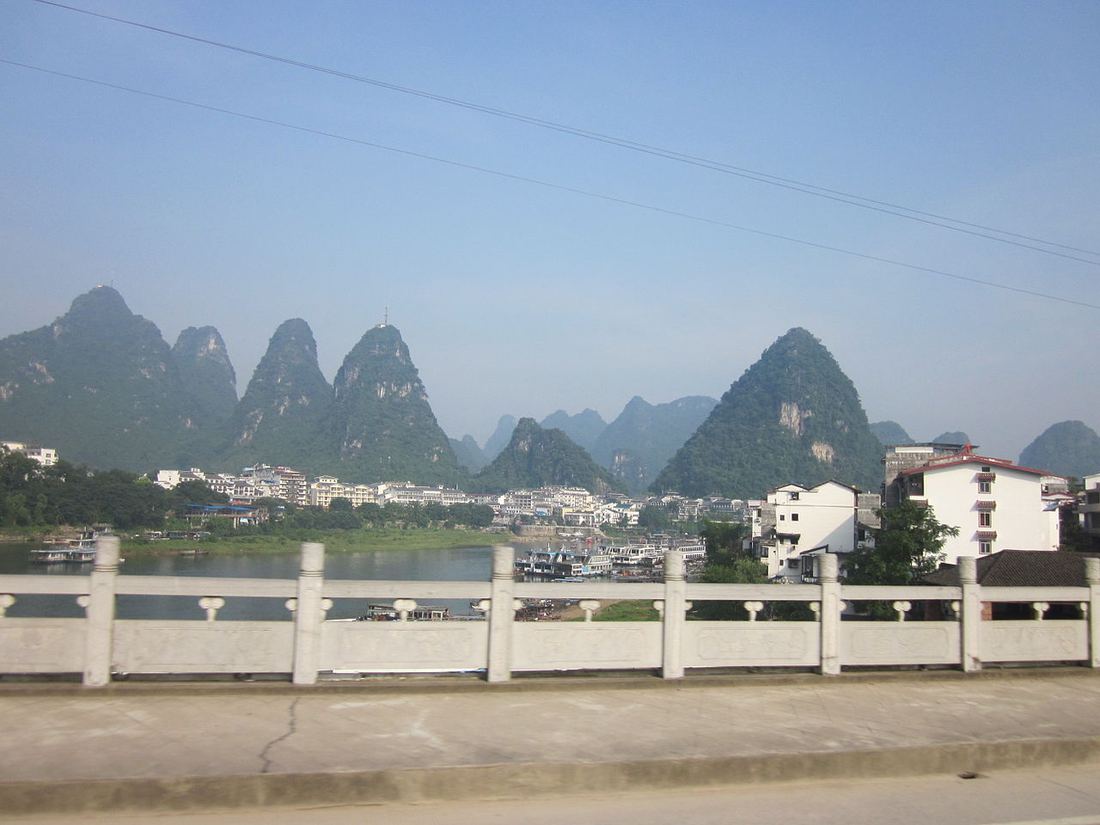
For a first mainland trip from Hong Kong, I usually suggest starting with something low-barrier and high-reward. Guilin and Yangshuo work well: about 3.5 hours by high-speed rail from West Kowloon, low altitude, little walking, mostly boats and vehicles, and scenery that genuinely is world-class. It suits elderly parents and young children.
If you want more dramatic landscapes, the Qinghai–Gansu Grand Loop is the other direction — eight to ten days, taking in Qinghai Lake, Chaka Salt Lake, the Mogao Caves at Dunhuang and Zhangye Danxia, with six distinct landscapes on one loop. Its demands are altitude (Qinghai Lake sits at about 3,196 m) and distance (over 2,000 km), so pacing matters more than the number of sights.
What does not change
The information for travelling from Hong Kong into the mainland is not hard to find. The difficulty is assembling the details: permit validity, crossing choice, hotel eligibility, pickup arrangement, payment and connectivity. Each looks small in isolation; any one of them going wrong shapes the mood of the whole trip.
We include all of these in the pre-departure checklist we give guests, and we raise the permit question when the itinerary is confirmed rather than the week before. If you are planning a first mainland trip, tell us your dates and group size and we will come back with a day-by-day itinerary and a preparation list.